The Mysteries of the Rosary: Complete Guide to All 20 Mysteries
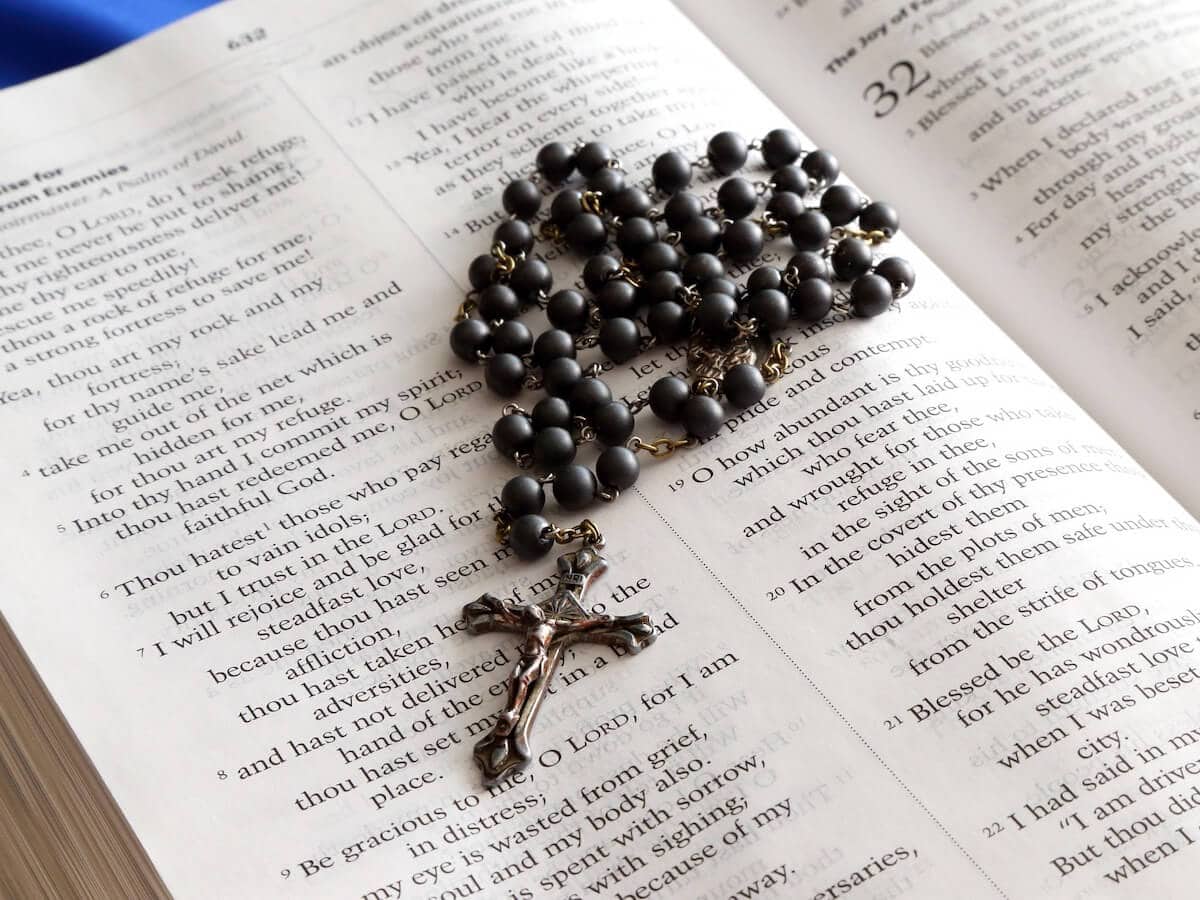
The Mysteries of the Rosary are at the center of any Rosary meditation. Each Mystery is a Gospel event that guides the prayerful mind to reflect on key moments in the life of Jesus and Mary.
Let’s take a walk through the four sets of Mysteries, when they are prayed and what five events fall into each to get a full understanding of the Mysteries, their purpose, and how to use them in prayer.
Disclosure: Some of the links below may be affiliate links. At no additional cost to you, we may earn a small commission if you make a purchase.
Quick Reference: Which Mysteries are prayed on which day?
- Monday: Joyful Mysteries
- Tuesday: Sorrowful Mysteries
- Wednesday: Glorious Mysteries
- Thursday: Luminous Mysteries
- Friday: Sorrowful Mysteries
- Saturday: Joyful Mysteries
- Sunday: Glorious Mysteries (outside Lent & Advent; during Lent, some communities substitute Sorrowful)
What are the Mysteries of the Rosary?
The Mysteries are twenty Gospel-centered scenes grouped into four sets (Joyful, Sorrowful, Glorious, Luminous). Each set contains five Mysteries. When praying a decade of the Rosary, the person reflects on one Mystery, combining vocal prayer (Our Father, Hail Mary, Glory Be) with brief meditation on the event and its meaning.
How to Use the Mysteries
- Choose the set according to the day (see schedule).
- Read the Scripture passage slowly before each decade.
- Summarize the event in one sentence and hold that image while praying the Hail Marys.
- Note the fruit and ask for that virtue in your life.
- Keep reflections short and concrete (e.g., “What does Jesus’ humility in this scene teach me?”).
Learn more about the Rosary and its significance.
The Joyful Mysteries
Prayed Mondays, Saturdays, and Advent Sundays
1. The Annunciation
The Annunciation recounts God’s messenger, Gabriel, announcing to Mary that she will conceive and bear the Son of God. Mary’s simple, free response, traditionally summarized as her “fiat” (“let it be done”), marks a decisive human consent to God’s plan. The scene combines divine initiative with human openness.
This Mystery centers on vocation and cooperation with God’s will. It highlights humility and obedience as the seeds of salvation.
“In the sixth month, the angel Gabriel was sent from God to a town of Galilee called Nazareth, to a virgin betrothed to a man named Joseph, of the house of David, and the virgin’s name was Mary.” – Luke 1:26–27
Fruit of the Mystery: Humility
2. The Visitation
Mary visits her relative Elizabeth, who is also pregnant (with John the Baptist). Elizabeth’s prophetic greeting recognizes the presence of the Messiah in Mary’s womb and celebrates God’s work. The encounter models Christian charity and mutual recognition of God’s action in others
The Visitation shows how faith prompts us toward neighborly service and joyful proclamation. It connects personal grace with communal witness.
“During those days Mary set out and traveled to the hill country in haste to a town of Judah, where she entered the house of Zechariah and greeted Elizabeth. When Elizabeth heard Mary’s greeting, the infant leaped in her womb, and Elizabeth, filled with the holy Spirit, cried out in a loud voice and said, ‘Most blessed are you among women, and blessed is the fruit of your womb.’” – Luke 1:39–42
Fruit of the Mystery: Love of Neighbor
3. The Nativity
The Nativity describes Jesus’ birth in Bethlehem under humble conditions. The scene contrasts royal identity with simple surroundings, a newborn King laid in a manger.
This Mystery emphasizes God’s entry into human vulnerability and ordinary life. God’s solidarity with the poor and marginalized is central here. Christians draw from the Nativity a call to simplicity and compassion.
“In those days a decree went out from Caesar Augustus that the whole world should be enrolled. This was the first enrollment, when Quirinius was governor of Syria. So all went to be enrolled, each to his own town. And Joseph too went up from Galilee from the town of Nazareth to Judea, to the city of David that is called Bethlehem, because he was of the house and family of David, to be enrolled with Mary, his betrothed, who was with child. While they were there, the time came for her to have her child, and she gave birth to her firstborn son. She wrapped him in swaddling clothes and laid him in a manger, because there was no room for them in the inn.” – Luke 2:1–7
Fruit of the Mystery: Poverty
4. The Presentation in the Temple
Mary and Joseph bring the infant Jesus to the Temple to fulfill the Law’s requirements. Simeon and Anna, prophetic figures, recognize the child as the fulfillment of God’s promises. The Presentation places the newborn within Israel’s covenantal life.
This Mystery shows continuity between God’s covenant and its fulfillment in Christ. It also highlights consecration and spiritual dedication.
“When eight days were completed for his circumcision, he was named Jesus, the name given him by the angel before he was conceived in the womb.
“When the days were completed for their purification according to the law of Moses, they took him up to Jerusalem to present him to the Lord, just as it is written in the law of the Lord, ‘Every male that opens the womb shall be consecrated to the Lord,’ and to offer the sacrifice of ‘a pair of turtledoves or two young pigeons,’ in accordance with the dictate in the law of the Lord.” – Luke 2:21-24
Fruit of the Mystery: Purity of Heart and Body
5. The Finding in the Temple
At twelve, Jesus is found in the Temple conversing with teachers and displaying understanding of Scripture. The episode highlights his growing human development and already-present divine wisdom. Mary and Joseph’s anxious search points to parental care and the mystery of Jesus’ identity.
The Finding emphasizes devotion to God and the importance of formation in faith. It portrays Jesus as both child and teacher.
“Each year his parents went to Jerusalem for the feast of Passover, and when he was twelve years old, they went up according to festival custom. After they had completed its days, as they were returning, the boy Jesus remained behind in Jerusalem, but his parents did not know it. Thinking that he was in the caravan, they journeyed for a day and looked for him among their relatives and acquaintances, but not finding him, they returned to Jerusalem to look for him. After three days they found him in the temple, sitting in the midst of the teachers, listening to them and asking them questions, and all who heard him were astounded at his understanding and his answers.” – Luke 2:41-47
Fruit of the Mystery: Devotion to Jesus
The Sorrowful Mysteries
Prayed Tuesdays, Fridays, and Lent Sundays
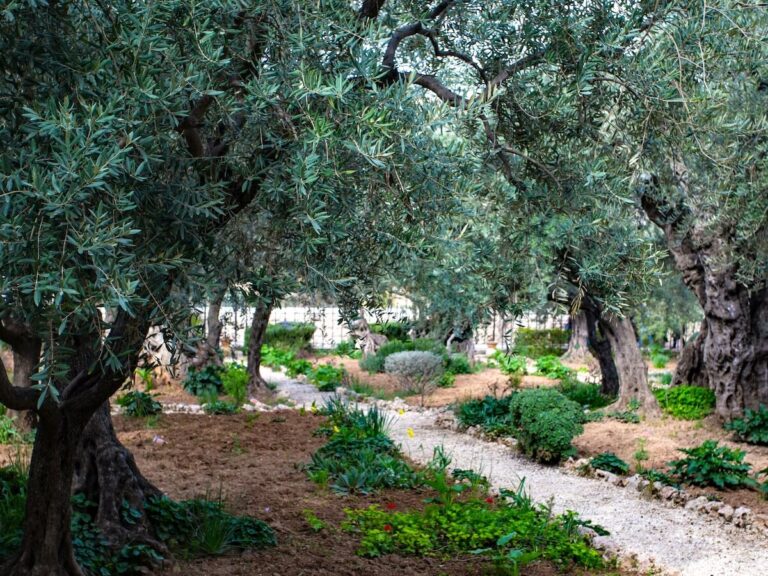
1. The Agony in the Garden
In Gethsemane, Jesus experiences intense sorrow and petitions the Father, yet submits to divine will. This scene reveals the human struggle with fear and the model of obedient surrender.
The Agony teaches how to entrust painful choices to God and models courage in accepting God’s plan even under severe stress.
“Then Jesus came with them to a place called Gethsemane, and he said to his disciples, ‘Sit here while I go over there and pray.’ He took along Peter and the two sons of Zebedee, and began to feel sorrow and distress. Then he said to them, ‘My soul is sorrowful even to death. Remain here and keep watch with me.’ He advanced a little and fell prostrate in prayer, saying, ‘My Father, if it is possible, let this cup pass from me; yet, not as I will, but as you will.’” – Matthew 26:36-39
Fruit of the Mystery: Obedience to God’s Will
2. The Scourging at the Pillar
Jesus endures a brutal whipping as part of his trial’s punishment. The physical suffering emphasizes the cost of redemption and the depths of Christ’s identification with human pain.
Meditating on this Mystery calls believers to repentance, self-discipline, and solidarity with those who suffer.
“Then he released Barabbas to them, but after he had Jesus scourged, he handed him over to be crucified.” – Matthew 27:26
Fruit of the Mystery: Mortification
3. The Crowning with Thorns
Soldiers mock Jesus by crowning him with thorns, a grotesque parody of royalty. The act deepens the humiliation he suffers and underscores the contrast between worldly power and Christ’s kingship.
This Mystery invites reflection on courage in the face of humiliation and the subversion of worldly values by divine truth.
“Then the soldiers of the governor took Jesus inside the praetorium and gathered the whole cohort around him. They stripped off his clothes and threw a scarlet military cloak about him. Weaving a crown out of thorns, they placed it on his head, and a reed in his right hand. And kneeling before him, they mocked him, saying, ‘Hail, King of the Jews!’” – Matthew 27:27-29
Fruit of the Mystery: Courage
4. The Carrying of the Cross
We see Jesus bearing the instrument of his own execution through the streets toward Golgotha, aided briefly by Simon of Cyrene. The journey to Calvary is a prolonged act of sacrifice and love.
This Mystery focuses on patient endurance and the call to carry one’s own crosses in daily life, often with the help of others.
“They pressed into service a passer-by, Simon, a Cyrenian, who was coming in from the country, the father of Alexander and Rufus, to carry his cross. They brought him to the place of Golgotha (which is translated Place of the Skull).” – Mark 15:21-22
Fruit of the Mystery: Patience
5. The Crucifixion and Death
The Crucifixion culminates Jesus’ Passion. Here sacrificial love reaches its peak: Jesus surrenders his life and opens the way to reconciliation. The scene is at once tragic and redemptive.
The Crucifixion is central to Christian soteriology, reflecting on it invites sorrow for sin and gratitude for grace.
“When they came to the place called the Skull, they crucified him and the criminals there, one on his right, the other on his left. [Then Jesus said, ‘Father, forgive them, they know not what they do.’] They divided his garments by casting lots. The people stood by and watched; the rulers, meanwhile, sneered at him and said, ‘He saved others, let him save himself if he is the chosen one, the Messiah of God.’ Even the soldiers jeered at him. As they approached to offer him wine they called out, ‘If you are King of the Jews, save yourself.’ Above him there was an inscription that read, ‘This is the King of the Jews.’ Now one of the criminals hanging there reviled Jesus, saying, ‘Are you not the Messiah? Save yourself and us.’ The other, however, rebuking him, said in reply, ‘Have you no fear of God, for you are subject to the same condemnation? And indeed, we have been condemned justly, for the sentence we received corresponds to our crimes, but this man has done nothing criminal.’ Then he said, ‘Jesus, remember me when you come into your kingdom.’ He replied to him, ‘Amen, I say to you, today you will be with me in Paradise.’
“It was now about noon and darkness came over the whole land until three in the afternoon because of an eclipse of the sun. Then the veil of the temple was torn down the middle. Jesus cried out in a loud voice, ‘Father, into your hands I commend my spirit’; and when he had said this he breathed his last.” – Luke 23:33-46
Fruit of the Mystery: Sorrow for our Sins
The Glorious Mysteries
Prayed Wednesdays and Sundays
1. The Resurrection
The Resurrection is the foundational event of Christian faith: Christ rising from the dead transforms death into life. The empty tomb signals victory over sin and the inauguration of new creation.
Meditating on the Resurrection strengthens faith and the expectation of eternal life.
“But at daybreak on the first day of the week they took the spices they had prepared and went to the tomb.They found the stone rolled away from the tomb; but when they entered, they did not find the body of the Lord Jesus. While they were puzzling over this, behold, two men in dazzling garments appeared to them. They were terrified and bowed their faces to the ground. They said to them, ‘Why do you seek the living one among the dead? He is not here, but he has been raised.’” – Luke 24:1-5
Fruit of the Mystery: Faith
2. The Ascension
After forty days, Jesus’ ascent into heaven marks the completion of his earthly ministry and his exaltation. Ascension points to Christ’s lordship and ongoing intercession for humanity.
This Mystery fosters Christian hope and the assurance of Christ’s presence and authority.
“So then the Lord Jesus, after he spoke to them, was taken up into heaven and took his seat at the right hand of God.” – Mark 16:19
Fruit of the Mystery: Hope
3. The Descent of the Holy Spirit (Pentecost)
At Pentecost the Spirit empowers the apostles for mission and unites the Church in diverse witness. The event inaugurates the Church’s public life and evangelizing mission.
Reflecting on Pentecost encourages reliance on the Spirit for wisdom and evangelistic boldness.
“When the time for Pentecost was fulfilled, they were all in one place together. And suddenly there came from the sky a noise like a strong driving wind, and it filled the entire house in which they were. Then there appeared to them tongues as of fire, which parted and came to rest on each one of them. And they were all filled with the holy Spirit and began to speak in different tongues, as the Spirit enabled them to proclaim.” – Acts 2:1-4
Fruit of the Mystery: Wisdom
4. The Assumption
The Assumption commemorates Mary’s being taken into heavenly glory. While Scripture does not narrate a historical account of the moment, Church tradition celebrates Mary’s participation in Christ’s victory and her body’s preservation in glory.
This Mystery points to hope in bodily resurrection and invites devotion to Mary as a model of discipleship.
“Behold, from now on will all ages call me blessed. The Mighty One has done great things for me, and holy is his name.” – Luke 1:48-49
Fruit of the Mystery: Devotion to Mary
5. The Coronation of Mary
The Coronation image draws on Revelation’s symbolism to present Mary as crowned queen in heaven. The scene honors her role in salvation history and her sharing in Christ’s triumph.
Meditation on this Mystery inspires longing for heavenly union and confidence in Mary’s maternal care.
“A great sign appeared in the sky, a woman clothed with the sun, with the moon under her feet, and on her head a crown of twelve stars.” – Revelation 12:1
Fruit of the Mystery: Grace of a Happy Death
The Luminous Mysteries
Prayed Thursdays
1. The Baptism of Christ in the Jordan
At his baptism, Jesus is publicly revealed as God’s Son and identified with sinners. The Spirit’s descent and the Father’s voice inaugurate his public ministry.
This Mystery emphasizes openness to the Spirit and the model of humility in service.
“After Jesus was baptized, he came up from the water and behold, the heavens were opened [for him], and he saw the Spirit of God descending like a dove [and] coming upon him. And a voice came from the heavens, saying, ‘This is my beloved Son, with whom I am well pleased.’” – Matthew 3:16-17
Fruit of the Mystery: Openness to the Holy Spirit
2. The Wedding Feast at Cana
At Cana Jesus performs his first public miracle, turning water into wine, at Mary’s intercession. The event signals the inauguration of signs that reveal his identity and compassion for human need.
The Wedding at Cana points to Mary’s role in bringing people to Jesus and to Jesus’ transformative power in ordinary life.
“On the third day there was a wedding in Cana in Galilee, and the mother of Jesus was there. Jesus and his disciples were also invited to the wedding. When the wine ran short, the mother of Jesus said to him, ‘They have no wine.’ [And] Jesus said to her, ‘Woman, how does your concern affect me? My hour has not yet come.’ His mother said to the servers, ‘Do whatever he tells you.’” – John 2:1-5
Fruit of the Mystery: To Jesus through Mary
3. Jesus’ Proclamation of the Coming of the Kingdom of God
Jesus’ central proclamation calls people to conversion and signals the arrival of God’s rule. Throughout his ministry he teaches, heals, and demonstrates what the Kingdom looks like.
Meditation on this Mystery calls for personal conversion and renewed adherence to the Gospel.
“’This is the time of fulfillment. The kingdom of God is at hand. Repent, and believe in the gospel.’” – Mark 1:15
Fruit of the Mystery: Conversion
4. The Transfiguration
On the mountain Jesus is transfigured in glory before three apostles, revealing his divine glory in anticipation of the Resurrection. The voice of the Father confirms his identity.
The Transfiguration inspires the Christian desire for holiness and for participation in divine life.
“After six days Jesus took Peter, James, and John his brother, and led them up a high mountain by themselves. And he was transfigured before them; his face shone like the sun and his clothes became white as light.” – Matthew 17:1-2
Fruit of the Mystery: Desire for Holiness
5. The Institution of the Eucharist
At the Last Supper Jesus institutes the Eucharist, giving his body and blood under the forms of bread and wine. The Eucharist becomes the central sacrament of Christian worship and spiritual nourishment.
Meditation on the Institution leads to adoration and deep appreciation for Christ’s abiding presence in the Eucharist.
“While they were eating, Jesus took bread, said the blessing, broke it, and giving it to his disciples said, ‘Take and eat; this is my body.’” – Matthew 26:26
Fruit of the Mystery: Adoration
The Rosary of the Seven Sorrows
The Rosary of the Seven Sorrows is a distinct Marian devotion that focuses specifically on seven sorrowful events in Mary’s life (Simeon’s prophecy, Flight into Egypt, Loss of Jesus, Meeting Jesus on the Way to Calvary, Crucifixion, Body Taken Down, Burial). It is not part of the four standard Rosary sets but is widely practiced as a Lenten or penitential devotion.
Learn all about the Seven Sorrows of Mary.
FAQ: Quick Answers to Common Questions
What is the Rosary mystery today?
See the day-by-day schedule above. Today’s Mystery corresponds to the day of the week (e.g., Monday = Joyful, Thursday = Luminous, Sunday = Glorious).
What are the 5 Mysteries of the Rosary?
Each “set” (Joyful, Sorrowful, Glorious, Luminous) contains five Mysteries. When someone asks “the 5 Mysteries,” they usually mean one set of five to be meditated together.
What is the Rosary of the Seven Sorrows?
A separate Marian devotion focusing on seven sorrowful events in Mary’s life; often prayed in Lent or at times of grief.
Do I have to pray all 20 Mysteries?
No. Many people pray one set (five Mysteries) daily or choose a full Rosary (all 20) on special occasions. The discipline is adaptable.
Which Rosary Mystery should I pray for a funeral?
The Sorrowful Mysteries are commonly prayed at funerals or vigils because they recall Christ’s suffering and death, though communities may also pray Glorious Mysteries to emphasize the Resurrection and hope.