The Church of the Holy Sepulchre in Jerusalem: The Ultimate Guide
The Church of the Holy Sepulchre is one of the most important Christian pilgrimage sites in the world. Located in Jerusalem’s Old City, the church is traditionally identified as the place of Jesus Christ’s crucifixion, burial, and resurrection.
For nearly 1,700 years, Christians have traveled to this site to pray, worship, and remember the final events of Jesus’ life. Today, the church is also an extraordinary historical complex, containing chapels, shrines, ancient stonework, archaeological remains, and sacred spaces cared for by several Christian communities.
For a first-time visitor, however, the church can be difficult to understand. It is not a single simple chapel, but a large and complicated complex built and rebuilt over many centuries.
This guide explains what the Church of the Holy Sepulchre is, why it is important, what you can see inside, its history, how the different Christian communities share the church, and what to know before visiting.
Quick answer: If you only have a short time, prioritize the Golgotha/Calvary, Stone of Anointing, Aedicule and Tomb of Christ, Chapel of St. Helena, and Katholikon. Then allow yourself time simply to walk through the church and take in its many chapels and traditions.
Plan Your Visit to the Church of the Holy Sepulchre
Quick Facts about the Church of the Holy Sepulchre
| Location | Christian Quarter, Old City of Jerusalem |
| Significance | Traditionally associated with the crucifixion, burial, and resurrection of Jesus |
| Original church | Consecrated in the 4th century under Constantine |
| Major historical periods | Byzantine, Crusader, Ottoman, modern |
| Main sacred areas | Golgotha, Stone of Anointing, Aedicule and Holy Tomb |
| Major Christian communities | Greek Orthodox, Roman Catholic (Latin), Armenian Apostolic, Coptic Orthodox, Syriac Orthodox, Ethiopian Orthodox |
| Governance | Shared according to the historic Status Quo arrangements |
| Best known feature | The Aedicule, which encloses the traditional Tomb of Christ |
Why is the Church of the Holy Sepulchre Important?
The importance of the Church of the Holy Sepulchre comes from its connection with the central events of Christian faith. According to Christian tradition, the site encompasses both Golgotha (Calvary), where Jesus was crucified, and the tomb where his body was laid after the crucifixion.
The Gospel accounts describe Jesus being crucified outside the walls of Jerusalem and buried in a nearby rock-cut tomb. The location now occupied by the church was outside the city walls during the time of Jesus, although Jerusalem expanded considerably in the centuries that followed.
In the 4th century, Emperor Constantine ordered the construction of a church at the site after Christian tradition identified the location of Jesus’ tomb and Golgotha. The resulting complex became one of Christianity’s earliest and most important pilgrimage destinations.
The church’s importance therefore has several layers:
- Religious: it is associated with the death and resurrection of Jesus.
- Historical: it has been a Christian pilgrimage destination since antiquity.
- Archaeological: the church contains evidence of Jerusalem’s changing landscape over many centuries.
- Architectural: its present form combines elements from different historical periods.
- Cultural: multiple Christian traditions have worshipped and maintained spaces within the complex for centuries.
Learn more about the History of the Church of the Holy Sepulchre.
Where is the Church of the Holy Sepulchre?
The Church of the Holy Sepulchre is in the Christian Quarter of Jerusalem’s Old City.
The church sits within the dense network of narrow streets that make up the Old City. It is close to other important Christian pilgrimage sites and forms the traditional destination of the Via Dolorosa.
The main entrance is reached through a modest doorway sometimes called the Door of Humility. Unlike the enormous cathedral façades found elsewhere in the world, the entrance can be surprisingly understated.
That is part of the experience of visiting the church: from the outside, it is easy to underestimate how large and historically complex the interior is.
Get Directions to the Church of the Holy Sepulchre.
What is Inside the Church of the Holy Sepulchre?
The Church of the Holy Sepulchre contains numerous chapels, altars, shrines, passageways, and areas associated with different Christian traditions.
For a first visit, these are the places you should know.
1. Golgotha (Calvary)
Golgotha, also known as Calvary, is traditionally identified as the place where Jesus was crucified. Inside the church, the traditional site of the crucifixion is located above the main floor and is reached by a staircase.
The area is divided between different Christian traditions, with altars and religious artwork marking the sacred space. For pilgrims, Golgotha is one of the most important places in the entire church.
Learn all about the Golgotha.
2. The Stone of Anointing
Near the entrance is a large stone traditionally associated with the preparation of Jesus’ body for burial.
According to Christian tradition, Jesus’ body was placed here after it was taken down from the cross and prepared for burial before being taken to the tomb. The current stone is a later replacement rather than the original stone from the time of Jesus.
Visitors often stop here to pray, kneel, or touch the stone.
The Stone of Anointing is important because it connects the two major events represented within the church: the crucifixion at Golgotha and the burial at the Holy Tomb.
Learn all about The Stone of Anointing in Jerusalem.
3. The Aedicule and the Tomb of Christ
At the center of the church’s Rotunda stands the Aedicule, the small shrine that encloses the traditional tomb of Jesus.
The name “Aedicule” comes from a word meaning a small shrine or structure. You may also see the spelling Edicule. The Aedicule contains two principal spaces:
- The Chapel of the Angel
- The Tomb Chamber
The Tomb Chamber contains the stone burial bench traditionally identified as the place where Jesus’ body was laid. The present Aedicule dates from the 19th century, although the structure has been rebuilt several times throughout its history.
A major conservation project in 2016–2017 allowed researchers to study and stabilize the shrine, including the ancient burial bed beneath its marble covering.
Because the Aedicule is one of the most important pilgrimage destinations in the church, lines can form to enter the tomb chamber.
Learn about the Aedicule of the Church of the Holy Sepulchre.
4. The Rotunda
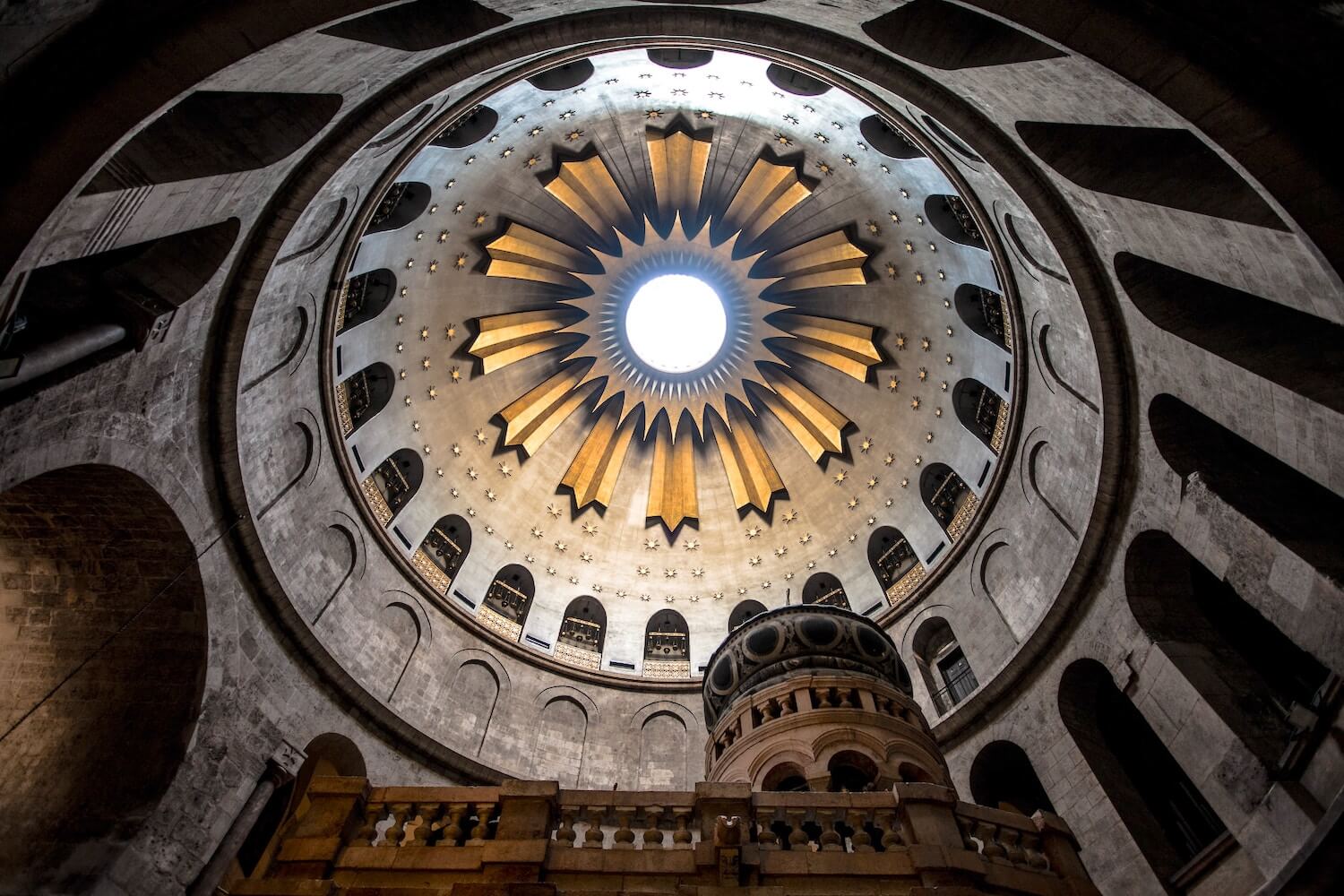
The Aedicule stands beneath the great dome of the church’s Rotunda.
The Rotunda is one of the most recognizable architectural spaces in the Holy Sepulchre. Its enormous circular interior draws attention toward the Aedicule at its center. The current structure reflects centuries of rebuilding and restoration rather than a single architectural period.
Standing inside the Rotunda also helps explain the church’s unusual layout: several sacred spaces that originally developed independently were eventually incorporated into a single complex.
5. Chapel of Saint Helena
The Chapel of Saint Helena is located in the lower part of the church. It is traditionally associated with Helena, the mother of Constantine, and her role in the discovery of the True Cross according to Christian tradition.
The chapel’s location below the main level of the church gives visitors a sense of the changing elevation and archaeological layers beneath the present building.
Learn about the Chapel of Saint Helena.
6. Chapel of the Finding of the Cross
Below the church is the Chapel of the Finding of the Cross, traditionally associated with Helena’s discovery of the True Cross. The chapel is part of the complex of underground spaces beneath the main church.
The story of Helena and the True Cross is an important part of the traditional history of the Holy Sepulchre, although the details belong to Christian tradition rather than independently established historical fact.
Learn about the Chapel of the Finding of the Cross.
7. The Katholikon
The Katholikon is the main Greek Orthodox worship space within the church. It occupies a prominent position facing the Aedicule and contains elaborate religious artwork, icons, mosaics, and other decorations.
The presence of the Katholikon illustrates an important feature of the Holy Sepulchre: this is not a museum or archaeological ruin. It remains an active place of worship where different Christian communities celebrate their liturgies according to their own traditions.
8. The Chapel of Adam
The Chapel of Adam lies beneath Golgotha. According to Christian tradition, Adam was buried beneath the place of the crucifixion. The symbolism connects Adam, associated with the fall of humanity, with Christ’s crucifixion and redemption.
The chapel is a good example of how biblical interpretation, Christian tradition, architecture, and pilgrimage have become intertwined within the Holy Sepulchre.
9. The Immovable Ladder
One of the strangest sights outside the church is a wooden ladder resting against a window ledge above the main entrance. It is known as the Immovable Ladder.
The ladder became associated with the complex arrangements governing the shared use of the church. Because changes to shared areas have historically required agreement between the communities involved, the ladder became a famous symbol of the Status Quo.
Its exact origin is less certain than the popular story sometimes suggests, but it has been documented since at least the 18th century.
Learn about The Immovable Ladder.
10. The Ethiopian Monastery and Other Chapels
The church complex includes spaces associated with several Christian traditions, including Ethiopian, Coptic, Syriac, Armenian, Roman Catholic, and Greek Orthodox communities. The Ethiopian Orthodox community has a particularly distinctive presence in the area around the church, including the Deir es-Sultan monastery on the roof.
Exploring these less prominent areas is one of the best ways to understand that the Church of the Holy Sepulchre is not simply one denomination’s church. It is a shared sacred complex with centuries of complicated relationships between Christian communities.
Learn about the Six Custodians of the Church of the Holy Sepulchre.
A Brief History of the Church of the Holy Sepulchre
The Church of the Holy Sepulchre has a history stretching back nearly 1,700 years. Its story is also a story of destruction, rebuilding, political change, pilgrimage, and religious cooperation.
Before the Church
During the time of Jesus, the area around today’s church was outside Jerusalem’s city walls. Christian tradition identified the location as the site of both Golgotha and the nearby tomb. The area subsequently changed dramatically as Jerusalem developed.
Constantine and the First Church
In the early 4th century, Emperor Constantine converted to Christianity and supported the construction of Christian churches throughout the Roman Empire.
According to tradition, his mother Helena traveled to the Holy Land and helped identify important sites connected with Jesus’ life. Constantine then ordered the construction of a monumental church complex over the traditional locations of Golgotha and the tomb. The church was consecrated in 335 CE.
Learn about the Complete History of the Church of the Holy Sepulchre.
Destruction and Rebuilding
The church has been damaged and rebuilt multiple times throughout its history. One of the most significant destructions occurred in 1009, when the Fatimid caliph al-Hakim ordered the destruction of the church.
The site was subsequently rebuilt, but the building continued to change as Jerusalem passed through different political and religious periods.
The Crusader Church
After the Crusaders captured Jerusalem in 1099, the Holy Sepulchre became the center of the Crusader kingdom’s religious life.
Major rebuilding during the Crusader period helped create much of the architectural form visitors recognize today. The Rotunda, entrance façade, chapels, arches, and other elements reflect this long process of construction and reconstruction.
The Status Quo
Over the centuries, several Christian communities developed rights to different parts of the church. Disputes over access, worship, repairs, ownership, and maintenance eventually contributed to the complex arrangement now known as the Status Quo.
The Ottoman authorities formalized the arrangement in the 19th century, freezing many of the rights and responsibilities that existed at the time. The Status Quo remains central to the way the church is managed today.
Learn about the Status Quo at the Church of the Holy Sepulchre.
Modern Restoration
The church continues to require extensive conservation. One of the most important recent projects involved the restoration of the Aedicule in 2016–2017.
The project allowed specialists to stabilize the structure and study parts of the tomb that had been concealed beneath later coverings for centuries.
Who Controls the Church of the Holy Sepulchre?
The Church of the Holy Sepulchre is shared by several Christian communities rather than being controlled by a single denomination. The principal communities involved are:
- Greek Orthodox
- Roman Catholic (Latin)
- Armenian Apostolic
- Coptic Orthodox
- Syriac Orthodox
- Ethiopian Orthodox
Each community has specific rights, spaces, chapels, altars, and liturgical responsibilities. The arrangements governing these rights are generally referred to as the Status Quo.
This system can seem complicated to visitors, but it is essential to understanding why the church looks and functions the way it does. For example, the timing of services, responsibility for particular spaces, restoration work, and even seemingly minor changes to the building can involve agreements between the communities.
Learn about the Six Custodians of the Church of the Holy Sepulchre.
The Holy Sepulchre as a Place of Pilgrimage
The church has been a destination for Christian pilgrims since late antiquity. For pilgrims, visiting the church is not simply about seeing an ancient building. The route through the church connects several moments in the Passion and Resurrection narratives.
A traditional pilgrimage may include:
- Walking through the Christian Quarter and approaching the church.
- Entering through the main doorway.
- Praying at the Stone of Anointing.
- Visiting Golgotha.
- Entering the Aedicule and Tomb of Christ.
- Visiting chapels associated with the Passion and early Christian traditions.
- Participating in liturgical services when possible.
The church is particularly significant during Holy Week, when Jerusalem receives large numbers of pilgrims for services and processions.
The Holy Fire Ceremony
One of the best-known annual traditions associated with the church is the Holy Fire ceremony, held on Holy Saturday according to the Eastern Orthodox calendar. The ceremony centers on the Aedicule and is of profound importance to many Orthodox Christians.
The tradition has a long documented history, although beliefs about the nature and origin of the fire differ depending on one’s religious perspective.
Learn about the Holy Fire Ceremony in Jerusalem.
How to Visit the Church of the Holy Sepulchre
The Church of the Holy Sepulchre is open to both pilgrims and visitors, but planning ahead makes the experience much easier. Before visiting, check the current opening hours and service schedule because access can be affected by religious ceremonies, holidays, crowd levels, and other circumstances.
Current Opening Hours | Current Mass and Service Times
How Much Time Should You Spend?
If you only want to see the principal sites, you can visit the church relatively quickly. However, I recommend allowing at least one to two hours if you want to explore the major chapels, understand the history, and spend time inside the church rather than simply checking off the main sights.
During major Christian festivals, queues and crowds can make the visit substantially longer.
When is the Best Time to Visit?
The best time depends on what you want from your visit. For a quieter sightseeing experience, avoid the busiest pilgrimage periods and major religious celebrations.
If your primary purpose is religious pilgrimage, however, visiting during Holy Week or another major celebration can be an extraordinary experience despite the crowds.
What Should You Wear?
The Church of the Holy Sepulchre is an active place of Christian worship. Visitors should dress modestly and behave respectfully, particularly when entering chapels or areas where services are taking place.
Keep voices low, follow instructions from clergy and church staff, and avoid interfering with people who are praying.
Can You Take Photos?
Photography policies can vary by location and circumstance. If photography is permitted, be conscious that you are inside an active place of worship. Avoid using flash where it may disturb worshippers, and always follow signs or instructions from church authorities.
The Church of the Holy Sepulchre and the Via Dolorosa
The Church of the Holy Sepulchre is traditionally regarded as the destination of the Via Dolorosa, the pilgrimage route through Jerusalem associated with Jesus’ journey to the crucifixion. The final stations are traditionally located within or immediately around the church.
For visitors following the Via Dolorosa, arriving at the Holy Sepulchre provides an opportunity to understand how the traditional pilgrimage route connects the streets of the Old City with the sacred spaces inside the church.
Learn about walking the Via Dolorosa.
Is the Church of the Holy Sepulchre Really the Tomb of Jesus?
This is one of the most common questions visitors ask. The answer depends on how the question is being framed.
Christian tradition identifies the church as the site of Jesus’ crucifixion, burial, and resurrection. The location has been venerated by Christians since antiquity.
At the same time, historians and archaeologists distinguish between the religious tradition surrounding a site and what can be proven with certainty from surviving evidence.
The present church incorporates a location that was outside Jerusalem’s walls in the 1st century and contains archaeological evidence of ancient quarrying and burial activity.
For Christians, however, the significance of the site does not depend solely on archaeology. It is the place where generations of pilgrims have come to remember the death and resurrection of Jesus.
Why Does the Church Matter So Much to Christians?
The Church of the Holy Sepulchre brings together the central events of Christian faith in one physical place. Here, pilgrims can encounter the traditional sites of:
- Jesus’ crucifixion
- Jesus’ burial
- the preparation of his body for burial
- the resurrection tomb
- the discovery of the True Cross according to Christian tradition
The church therefore represents more than a historical monument. It is a living place of prayer and worship where Christians from different traditions have maintained their own liturgies and devotional practices for centuries.
Frequently Asked Questions
The Church of the Holy Sepulchre is a historic Christian church in Jerusalem’s Old City traditionally associated with the crucifixion, burial, and resurrection of Jesus Christ.
It is located in the Christian Quarter of Jerusalem’s Old City, near the traditional route of the Via Dolorosa.
It is important because Christian tradition identifies the site with Golgotha, where Jesus was crucified, and the tomb where he was buried and resurrected.
Yes. The church welcomes both pilgrims and tourists, although access can be affected by religious services, holidays, and crowd-control measures. Plan Your Visit.
No, visiting the Church of the Holy Sepulchre is free of charge, regardless of religion.
A quick visit can take less than an hour, but allowing one to two hours gives you more time to see the major sacred spaces and explore the church.
The most important areas for a first-time visitor include:
Golgotha (Calvary)
The Stone of Anointing
The Aedicule and Tomb of Christ
The Rotunda
Chapel of Saint Helena
Chapel of the Finding of the Cross
Katholikon
Chapel of Adam
Immovable Ladder
Visitors can generally enter the Tomb Chamber inside the Aedicule when access is available. Lines can be long because it is one of the most important pilgrimage destinations in the church.
The church is not simply owned by one Christian denomination. Several Christian communities have historic rights and responsibilities within the complex under the Status Quo arrangements.
The Status Quo is the system of agreements and practices governing the rights, responsibilities, worship schedules, and shared spaces of the Christian communities that care for the Church of the Holy Sepulchre.
The Aedicule is the small shrine in the center of the Rotunda that encloses the traditional Tomb of Christ. View the complete Aedicule guide.
The Stone of Anointing is the stone near the church’s entrance traditionally associated with the preparation of Jesus’ body for burial. View the Stone of Anointing guide.
Golgotha, also called Calvary, is the traditional site of Jesus’ crucifixion. Within the Church of the Holy Sepulchre, it is located above the main floor and is marked by chapels and altars. View the Golgotha guide.
The Immovable Ladder is a wooden ladder associated with the facade of the church and the complex history of the Status Quo arrangements. View the Immovable Ladder guide.
Plan Your Visit to the Church of the Holy Sepulchre
The Church of the Holy Sepulchre is one of the most extraordinary places to visit in Jerusalem, but it rewards preparation. Before you go, check the latest:
- Opening hours
- Mass and service times
- Visitor guidelines
- Directions
- Religious holiday schedules
- Current access information
Plan Your Visit to the Church of the Holy Sepulchre Now
Once inside, don’t rush from one sight to the next. Take time to look at the architecture, observe the different Christian traditions represented throughout the building, and remember that this is still an active place of worship.
The Aedicule, Golgotha, Stone of Anointing, chapels, icons, mosaics, and ancient stonework each tell part of the story. Together, they explain why the Church of the Holy Sepulchre has remained one of Christianity’s most important pilgrimage destinations for almost seventeen centuries.