Holy Sacrament of the Eucharist: Meaning, History, and Understanding
The First Eucharist, also known as First Communion, is one of the most meaningful moments in a Christian’s spiritual journey. It is the first time a baptized believer receives the Holy Eucharist, the sacrament Christians have celebrated since the time of Jesus Himself.
While it is often associated with childhood ceremonies, white clothing, and family gatherings, First Eucharist is far more than a milestone event. It is a true sacramental encounter that introduces the believer to the center of Christian worship and faith.
For those unfamiliar with Christian practice or sacramental theology, First Eucharist can seem confusing. Questions naturally arise: What is First Eucharist? What exactly is the Eucharist? Is it symbolic or something more? Is the Eucharist only a Catholic thing? Who can receive Holy Communion, and who cannot?
Let’s answer those questions and dive into the meaning, history, and theology of the Sacrament of the Eucharist.
Disclosure: Some of the links below may be affiliate links. At no additional cost to you, we may earn a small commission if you make a purchase.
What is the First Eucharist?
To understand what is the First Eucharist, also known as the First Holy Communion, it is essential to first understand what is the Eucharist.
The definition for Eucharist comes from the Greek word eucharistia, meaning “thanksgiving.” In Christianity, the Eucharist is the sacrament in which bread and wine are consecrated and received as Christ’s Body and Blood. The First Eucharist is the first time a baptized Christian receives this sacrament personally and fully.
First Eucharist is not merely a ceremony or symbolic rite of passage. It is the moment when a believer begins active participation in the Church’s central act of worship: the Holy Communion Eucharist. From that point forward, the individual is invited to receive Communion regularly as part of the Christian community.
How to Pronounce Eucharist
Because the word is unfamiliar to many, pronouncing Eucharist can be a bit tricky. It is typically pronounced:
YOO-kuh-rist
The term has been used by Christians since the earliest centuries and reflects the sacrament’s roots in Scripture and early Church worship.
Is the Eucharist a Sacrament?
Yes. The Eucharist itself is one of the seven sacraments recognized in Catholic Christianity, and First Eucharist is the first reception of the Sacrament of the Eucharist. While First Eucharist is sometimes treated culturally as a single event, the Church understands it as the beginning of a lifelong sacramental relationship.
Sacraments are believed to confer grace. At that first Eucharist, the believer does not simply remember Jesus, but encounters Him in a real and transformative way.
Eucharist vs Communion: Is There a Difference?
A common question is: What’s the difference between Communion and Eucharist?
The terms refer to the same sacrament but emphasize different aspects:
- Eucharist emphasizes thanksgiving and sacrifice
- Communion emphasizes unity and participation
Thus, phrases such as holy communion, eucharist communion, and holy communion eucharist all describe the same sacred reality. First Eucharist and First Communion are generally interchangeable terms.
First Eucharist Meaning and Why It Matters
The first Eucharist meaning goes far beyond receiving bread for the first time. Spiritually, it marks a transition from observing the Eucharist to fully sharing in it.
At First Eucharist, the believer:
- enters into deeper communion with Jesus Christ
- participates personally in Christ’s sacrifice and thanksgiving
- becomes fully involved in the Church’s sacramental life
The Eucharist is often described as spiritual nourishment. Just as food sustains the body, the Eucharist sustains the soul. First Eucharist is the beginning of receiving that nourishment regularly.
Eucharist Wafer and Symbolism
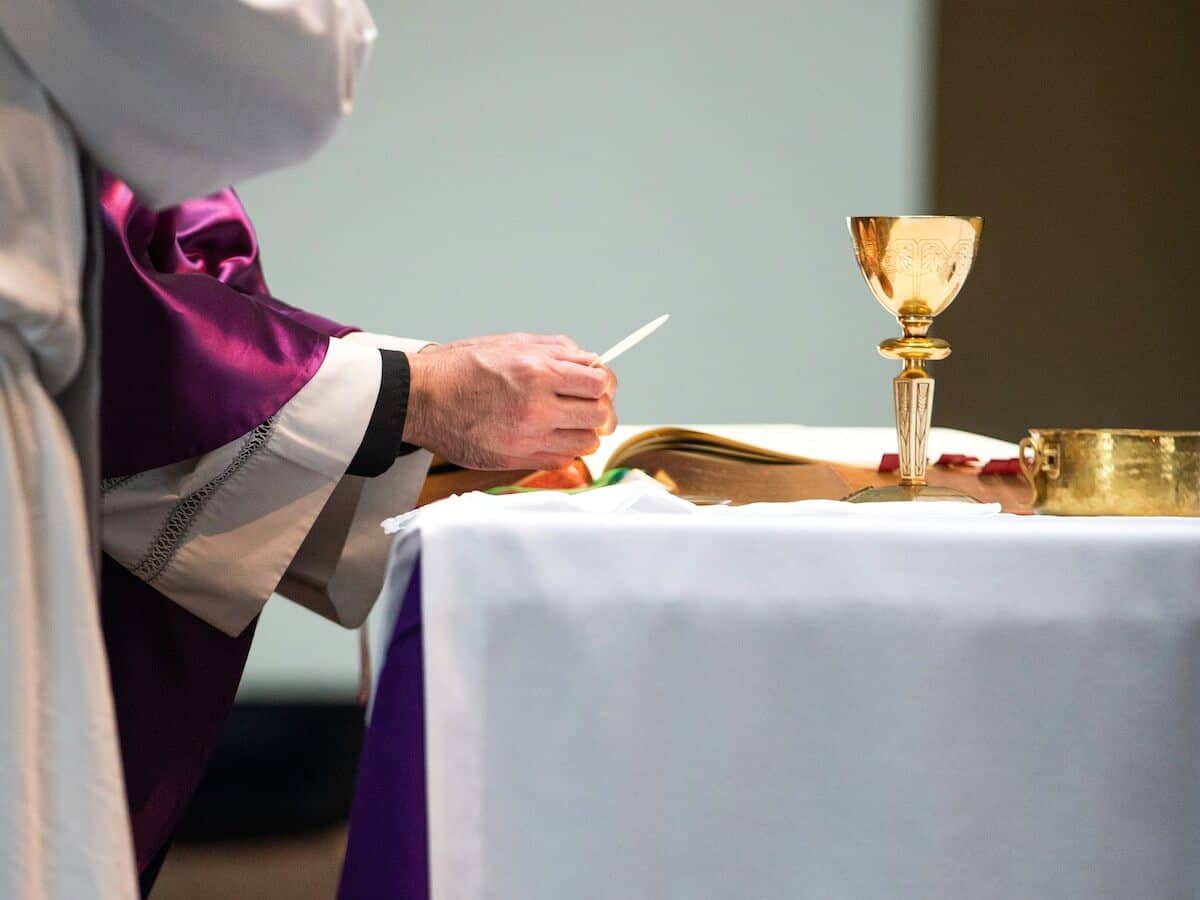
The Eucharist wafer, often called the host, is unleavened bread used in Catholic celebrations. Though simple in appearance, Catholics believe it becomes the Body of Christ after consecration.
The Eucharist is rich in symbol:
- bread and wine represent nourishment and sacrifice
- the altar represents Christ’s offering
- receiving Communion represents unity with Christ and the Church
The Last Supper: The Origin of the Eucharist
Every celebration of the Eucharist, and every First Eucharist, traces its origin to the Last Supper.
On the night before His crucifixion, Jesus gathered His disciples for a Passover meal. During that meal, He took bread, blessed it, broke it, and said, “This is my body, which is given for you.” He then took a cup of wine and declared it “the new covenant in my blood.”
At the Last Supper, Jesus:
- identified bread and wine with His own Body and Blood
- connected the meal to His sacrifice on the Cross
- commanded His followers to repeat this act in remembrance of Him
When a child or adult receives First Communion, they are participating in this same sacred action, established by Jesus Himself.
First Eucharist and the Bible
The Eucharist in the Bible extends far beyond the Last Supper.
In John chapter 6, Jesus proclaims Himself the Bread of Life and says that those who eat His flesh and drink His blood will have eternal life. This teaching shocked many listeners, yet Jesus did not soften His words.
The Old Testament also prepares the way for the Eucharist:
- manna from heaven feeding the Israelites
- the Passover lamb whose blood brought deliverance
- covenant meals sealing God’s promises
These biblical foundations help explain Eucharist meaning and significance and why First Eucharist is understood as part of God’s ongoing plan of salvation.
Who Receives First Eucharist?
Traditionally, First Communion is received by children who have reached the “age of reason,” usually around seven years old. At this age, children are considered capable of understanding that the Eucharist is not ordinary bread.
Adults also receive First Eucharist, particularly converts to Christianity or Catholicism. In these cases, First Eucharist often occurs alongside Baptism and Confirmation.
Differences Across Christian Denominations
While First Eucharist is most strongly emphasized in Catholic practice, other Christian denominations also celebrate Communion.
- Catholic and Orthodox Churches teach the real presence of Christ in the Eucharist
- Anglican and Lutheran traditions hold sacramental understandings
- Many Protestant communities view Communion as symbolic but deeply sacred
The timing, theology, and preparation for First Communion vary, but the practice of remembering the Last Supper is shared across Christianity.
Eucharistic Miracles
Throughout Christian history, there have been reported accounts of Eucharistic miracles, sometimes referred to as miracles of the Eucharist. These are extraordinary events in which the consecrated host or wine is said to manifest in a visible or physical way. Most commonly through bleeding, transformation of the host’s appearance, or preservation beyond natural explanation.
Within the Catholic tradition, Eucharistic miracles are never treated lightly. Claims are subjected to careful theological, historical, and scientific investigation. The Church approaches such events with caution, recognizing that faith in the Holy Eucharist does not depend on miracles, but on the words and actions of Jesus at the Last Supper.
When the Church does acknowledge a Eucharistic miracle, it does so for a specific purpose: to reaffirm belief in the real presence of Christ in the Eucharist, especially in times or places where faith may be weak or questioned. These miracles are understood not as spectacles, but as signs meant to draw believers back to reverence, repentance, and deeper trust in Christ.
Importantly, Eucharistic miracles are never considered replacements for the sacrament itself. The Church teaches that Christ is fully present in every valid celebration of the Eucharist, whether or not anything extraordinary is visible. Miracles, when they occur, are meant to point back to the ordinary yet profound reality of the Eucharist celebrated daily around the world.
Eucharistic Adoration in the Church
Eucharistic adoration is a devotional practice rooted directly in belief in the real presence of Christ in the Eucharist. Because Catholics believe that Jesus remains truly present in the consecrated host even after Mass has ended, the Eucharist may be reserved and displayed for prayer.
During Eucharistic adoration, the consecrated host is typically placed in a monstrance and set upon the altar. Worshippers may come forward to pray silently, read Scripture, meditate, or simply remain in the presence of Christ. Unlike the Mass, adoration does not involve receiving Communion; instead, it focuses on contemplation and worship.
Eucharistic adoration flows naturally from the sacrament itself. If the Eucharist is truly Christ’s Body and Blood, then time spent in His presence becomes an extension of Communion rather than something separate from it. For many believers, adoration deepens understanding of the Eucharist, fosters interior stillness, and strengthens reverence for receiving Holy Communion.
Rules on the Eucharist
The Church’s guidelines on receiving Holy Communion are often misunderstood as rigid rules. In reality, they are meant to safeguard both the dignity of the sacrament and the spiritual well-being of the person receiving it.
Who May Receive the Eucharist?
Ordinarily, a person receiving Holy Communion should:
- be baptized Catholic or formally received into the Catholic Church
- believe in the real presence of Christ in the Eucharist
- be properly disposed, meaning not conscious of unconfessed mortal sin
- observe the one-hour Eucharistic fast
These conditions express the belief that receiving Communion is not a private act, but a public expression of unity with the Church’s faith.
Can You Take Communion if You Live with Your Boyfriend or Girlfriend?
Living arrangements by themselves are not the sole determining factor. However, the Church teaches that sexual relations outside of marriage constitute grave matter. A Catholic who is conscious of ongoing serious sin is asked to refrain from receiving Communion until reconciliation has taken place.
This guidance is not meant as judgment or exclusion. Rather, it reflects the belief that Communion should flow from a life oriented toward repentance, honesty, and healing. Many people in these situations are encouraged to seek pastoral guidance rather than make assumptions.
Can a Divorced Catholic Receive Holy Communion?
Divorce alone does not prevent a Catholic from receiving Communion. A divorced Catholic who has not remarried may ordinarily continue to receive the Eucharist.
If a person has remarried outside the Church without an annulment, the situation becomes more complex, as the Church understands the original marriage bond to remain. In such cases, individual pastoral guidance is strongly encouraged, as circumstances vary widely.
Who Cannot Receive Communion as a Catholic?
In general, the Church asks the following to refrain from receiving Holy Communion:
- those who are not baptized Catholics
- Catholics who do not believe in the real presence of Christ in the Eucharist
- those conscious of unconfessed mortal sin
- those who have not observed the Eucharistic fast (unless exempt for health reasons)
Those who do not receive Communion are encouraged to remain prayerfully present and may make a spiritual communion, expressing desire for union with Christ.
Preparing for First Eucharist
Preparation for First Eucharist is not only about learning facts. It is about forming understanding, reverence, and habit.
Spiritual Preparation
- Learn what the Eucharist is and why it matters.
- Understand the difference between ordinary bread and the consecrated host.
- Develop a simple, regular prayer life.
- Learn the meaning of repentance and forgiveness.
- Celebrate the Sacrament of Reconciliation when appropriate.
Knowledge and Understanding
- Know the basic structure of the Mass.
- Understand the words of consecration and their connection to the Last Supper.
- Learn appropriate gestures of reverence (standing, kneeling, silence).
- Understand why fasting before Communion is practiced.
Practical and Family Preparation
- Attend Mass regularly before First Eucharist.
- Discuss the meaning of the sacrament at home.
- Practice approaching and receiving Communion reverently.
- Emphasize meaning over appearance or celebration.
After First Eucharist: What Comes Next?
- Growth in moral and spiritual life.
- Regular participation in Sunday Mass.
- Ongoing reception of Holy Communion.
- Continued learning about the faith.
Why First Eucharist Matters So Deeply
The First Eucharist is not simply a childhood ceremony, a photograph-worthy moment, or a box to check in religious education. It is the first conscious encounter with what the Catholic Church believes is the real and living presence of Jesus Christ. From that moment forward, the believer is no longer only observing the Church’s central mystery but actively participating in it.
At that first Eucharist, the individual is drawn into the rhythm of Christian life itself. A life shaped by sacrifice, thanksgiving, communion, and transformation. The Eucharist unites believers not only to Christ, but to one another, across time and place. Every Mass echoes the Last Supper; every Communion joins the present moment to Christ’s saving act.
For this reason, the Church places such care around preparation, understanding, and reverence. First Eucharist marks the beginning of a lifelong relationship with the sacrament at the heart of Christian faith. Whether received as a child or as an adult, it opens the door to continual spiritual nourishment, growth, and belonging within the Church.
FAQs about First Eucharist and Holy Communion
Is First Eucharist the Same as First Communion?
Yes. First Eucharist and First Communion refer to the same sacramental moment: the first time a baptized person receives the Eucharist. The difference in wording reflects emphasis rather than substance. “Eucharist” highlights the sacrament itself, thanksgiving, sacrifice, and real presence, while “Communion” emphasizes the act of receiving and being united with Christ and the Church.
Both terms are correct, and both are widely used.
What Exactly is Being Received at First Eucharist?
According to Catholic teaching, the bread and wine consecrated at Mass truly become the Body and Blood of Christ, even though they retain the outward appearance of bread and wine. This belief is known as the real presence.
At First Eucharist, the recipient is not merely participating in a symbolic ritual. They are receiving Christ Himself, spiritually and sacramentally. This is why preparation focuses so strongly on understanding, reverence, and faith.
What Age is First Eucharist, and Why?
First Eucharist is typically received around the age of seven, often referred to as the “age of reason.” At this stage, a child is considered capable of understanding the basic difference between ordinary food and the Eucharist, as well as the importance of reverence.
This age is not arbitrary. It reflects the Church’s belief that a person should be able to recognize that the Eucharist is sacred before receiving it. Adults who were not raised Catholic or who did not receive First Communion as children may receive First Eucharist later in life after proper instruction.
Do Adults Have a First Eucharist?
Yes. Adults who convert to Catholicism or return after long absence also experience a First Eucharist. For adults, it often occurs after a period of instruction and spiritual preparation, sometimes alongside Confirmation.
For many adult converts, First Eucharist is an especially powerful experience because it follows a conscious decision to embrace Catholic faith and sacramental life.
What If Someone Misses First Communion as a Child?
Missing First Communion as a child does not prevent someone from ever receiving the Eucharist. The Church welcomes those who seek the sacrament later in life. With appropriate instruction and preparation, First Eucharist can be received at any age.
This situation is more common than many realize and is approached pastorally rather than punitively.